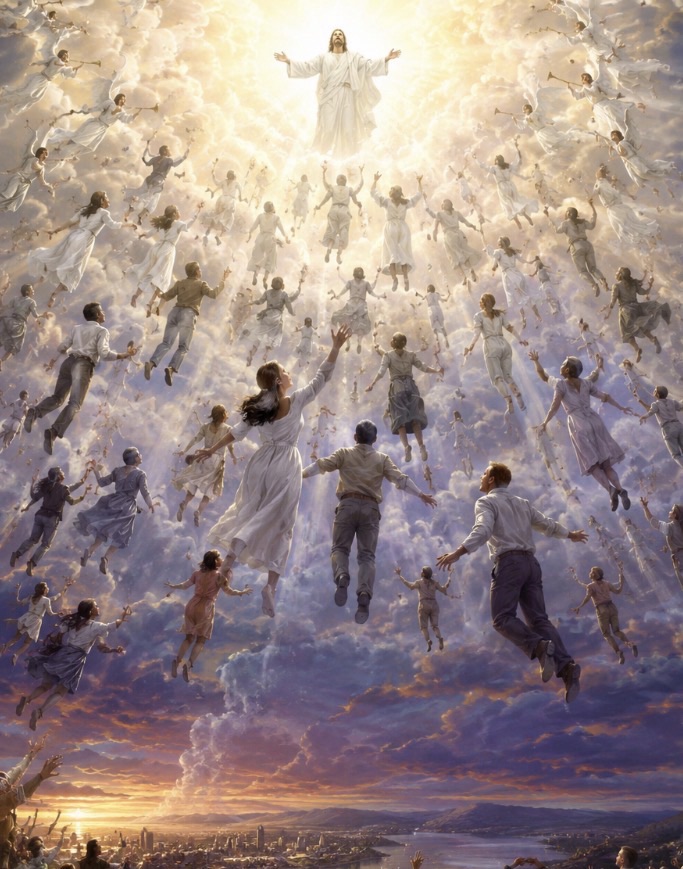
THE RAPTURE, ACCORDING TO THE SCRIPTURES
“The supernatural removal of the church of Jesus Christ out of this world is called the rapture. The term rapture comes from the Latin word rapturo. This is the Latin translation of the Greek verb “caught up,” which is found in 1 Thessalonians 4:17. The word denotes a sudden, irresistible act of carrying off by force. In that passage the apostle Paul teaches that true believers in Christ will suddenly be caught up into the air by the power of Christ and will meet Him in the air. This idea of the sudden removal of God’s people through powerful, divine activity has no parallel in Old Testament literature. In the New Testament, a number of passages speak of Christ’s coming for His church.”
Benware, Paul N., 1942- Understanding end times prophecy : a comprehensive approach / Paul N. Benware. p. cm. Includes bibliographical references and indexes. ISBN-13: 978-0-8024-9079-7
THE RELATION OF THE DAY OF THE LORD TO THE RAPTURE OF THE CHURCH
5:1 The opening phrase of verse 5:1 (two words in the Greek, translated “but” or “now”) indicates that the Day of the Lord does not include the Rapture. That opening phrase, peri de, Paul uses regularly in his letters to introduce a new subject (see 1 Cor. 7:1, 25; 8:1; 12:1; 16:1, 12; 1 Thess. 4:9; 5:1). Therefore, Paul is indicating that the “Day of the Lord” is a new subject from the Rapture, which he has described in the preceding paragraph. This conclusion is reinforced by the fact that Paul elsewhere calls the Rapture a mystery (1 Cor. 15:51), which is something not revealed in the Old Testament but revealed in the New Testament. The Rapture is not revealed in the Old Testament, whereas the Day of the Lord is. The expression “day of the Lord” occurs 20 times; “last days,” 14 times; “that day,” 100 times. Obviously the Day of the Lord was well known from the Old Testament and was included in Paul’s teaching about the future. Since the Rapture is not a part of the Day of the Lord, then it must occur before the beginning of the Day, i.e., before the Tribulation begins. Thus the Rapture cannot be within the Tribulation (midtribulationism) or at the end with the Second Coming (posttribulationism).
Ryrie, Charles Caldwell, 1925–2016
First and Second Thessalonians / Charles Caldwell Ryrie. p. cm. — (Everyman’s Bible commentary)
Includes bibliographical references.
ISBN 0-8024-7110-2
What should I do to be ready?
Being ready for the rapture begins with a personal relationship with Jesus Christ. The New Testament teaches that salvation is by God’s grace through faith in Christ, not by human effort or good works. Trust in Jesus as your Lord and Savior, believing that He died for your sins, was buried, and rose again (see 1 Corinthians 15:1–4 and Ephesians 2:8–9). Your confidence rests in His finished work, not in your performance.
Helpful Resources
If you would like to better understand, rapture of the church we have provided the links below:

